Artificial Fragrance redesign
Overview
Perfume and cologne have been gendered products since around the 1950s. However, it was not always this way. Both fragrances were intended for both men and women, but have developed into an unnecessarily gendered product. Research has revealed that the products have become gendered due to specific branding and advertising methods.
This project addresses this problem and the goal was to redefine the way that perfume and cologne are portrayed in the media to eliminate the idea that cologne is made only for men and perfume is strictly for women. This project will circle back to the idea that fragrances are universal products by changing the way that these products are marketed to the public. Advertising plays a major role in our society, so the focus of this project was to develop advertising that would appeal to all genders. It can be hypothesized that if cologne and perfume are advertised in a less gendered manner, then people will be more willing to purchase different fragrances.
This page will explain each step of the project process that led to the finalized project, including research that was gathered, insights, and the project design deliverables.
Research
This research began with the question "why are fragrances gendered in the first place?" To answer this question, many literature resources were reviewed to gather an understanding of the history of fragrances and how they have gotten to where they are today.

It is important to remember that the only difference between perfume and cologne is the ratio between oil concentration and alcohol content. Perfume has a stronger scent that lasts longer, with an oil concentration of 20-30%. Cologne has a weaker scent that does not last as long with an oil concentration of 2-4%.
Perfume was created a long time ago, way before cologne. It was originally made out of incense by the Mesopotamians and was mainly used for religious ceremonies. It spread across the world to Ancient Egyptians, Greeks, and Romans and into the Islamic World. The concept was kept alive by the Islamic World during the Dark Ages, where the spread of Christianity led to a decrease in hygiene during this time.
Perfume gained popularity again around the 17th century in France. This time period shifted the purpose of perfume from religious reasons to masking body odors.


Cologne entered society around 1709 and was created by an Italian man named Giovanni Maria Farina. He named the product after Cologne, Germany, which was where he lived. The product immediately gained popularity.
Perfume and cologne began to become gendered products in the modern era, when advertising began to follow the idea that "sex sells."Males and females have been over-sexualized in fragrance advertising so much that people began to associate perfume with women and cologne with men. The advertising became further divided when brands began using gender-specific terms, fonts, colors, and scents.


Pre-Design Surveys
After this initial background research was conducted, additional research was gathered in the form of peer feedback. A Google form was sent out to both male and female peers that asked questions about their fragrance preferences. There were 22 survey responses and 81% of them were female and a majority of them used perfume or no fragrance at all.
The survey questions mostly focused on asking the participants to rank the most important factors to them when they purchased fragrances on a scale from 1 to 10, with 10 being the most important. It is important to note of the fact that the only factor that almost everyone ranked as a 10 was "scent." The rest of the ranking results widely varied, but most people did not really care about the color of the fragrance liquid, the color of the label, the fragrance advertisements in magazines, commercials, and the celebrities or models featured in the ads. It appeared that brand name , product name, bottle shape, and the bottle color had some of an effect on fragrance purchasing decisions.
Some of the questions on the survey asked if participants used perfume, would they consider switching to cologne and vice versa. Most participants stated that even if they like the scent of cologne or perfume, they would not switch to the other because they enjoy the fragrance that they currently use. However, there were a few very interesting responses that reinforced the previous research that was conducted, including:
"No, perfume is meant for women and I am man"
"Probably not because it's gendered. I would buy it for a male partner though!"
"I don't purchase perfume it is for women"
"No it is too masculine"
"I think if it's not a traditional musky or 'manly' smell. I don't think cologne is inherently meant for masculine people but many of them cater to that area. I like fruit and flowery smells and I don't see a lot of that in colognes"
The final survey question asked if people would consider purchasing gender neutral fragrances. This question received a lot of positive feedback and the participants seemed very open to it, as long it smelled good.
"I would because they’d probably smell good and not have uncomfortable names/shapes/celebrities attached."
"Potentially, it all comes down to the scent itself so I don't care what/who it is for."
"Yes; smell is smell, gender isn’t associated with it for me, if I enjoy it I’ll buy it."
"Yeah, I don't see why not. I think it would be amazing for people who don't want to label themselves or align themselves with the binary...Something neutral would be great as long as it makes me smell good!"
Designs
The next stage of this process was to move on from the research and begin designing. It became clear from the survey that the brand of the product is important to certain people, and a concern was that certain people would associate an already-existing brand with perfume or cologne. It would be too difficult to convince them to imagine the brand as something else. These reasons led to the decision of creating a new fragrance brand from scratch and the brainstorming began. All initial brainstorming was performed on Adobe Illustrator.


"Eros" was chosen as the brand name because of the history that is tied to the name. It was originally intended to choose a name related to a Greek mythological figure that had been portrayed as both male and female in some stories. However, all of those figures had names that were slightly difficult to pronounce. While Eros is not typically portrayed as multiple genders, he was typically described in androgynous ways. He was described in stories as both beautiful and handsome, terms that are both used in gendered ways. Additionally, Eros is known for playing a role in many love stories. His famous arrows would make a person fall in love with the first person that they saw. This type of love was not limited to specific genders. Therefore, Eros felt like an appropriate figure to represent this brand.
Once the brand brainstorming was complete, it was time to move on to the creation of the design mockups. Additional research was done to determine the appropriate bottle shape, color scheme, and font styles so that the product would attract both genders equally.


These prototypes helped move the process moved forward into developing the beginning of the final product, the fragrance advertisements. To accomplish the advertisement designs below, fragrance bottles were ordered online as close as possible to the bottle shape originally designed. A photoshoot of these bottle took place and the materials for the photoshoot included the bottles, a bed sheet, and lighting materials.
p
h
o
t
o
s
h
o
o
t


Advertisement Designs


The photos were worked on in Adobe Photoshop to include the label designs and give them a more professional look. The original plan was to paint on the labels or print them out, but it was found to be easier to directly apply them in photoshop. The goal of the photo editing was to make the images feel magazine-ready.
The overall main goal of these advertisements was to remove all gendered fragrance factors without making the product bland and boring. The idea of gold and silver creates a sense of elegance and richness, so the images were aimed to capture that idea of luxury. Additionally, the whole brand is based around a Greek mythological figure. The Ancient Greek culture was represented in these images.


Post-Design Surveys
There were too many design options, so it was necessary to receive feedback from peers. First, both males and females were asked to pick their favorite Silver advertisement and their favorite Gold advertisement. The results were unanimous and these two ads were chosen:


After the advertisements were chosen, a survey was sent out to the public to determine their opinions on the product and advertisements as a whole. Despite the survey being posted in multiple large Facebook groups and sent to many people, there were only 11 responses. Similar to the last survey, the responses were 72% female. When asked which advertisement the participants preferred, 72% answered with Silver.
There was another section that asked the participants to rank the factors that they liked or disliked about the product. Most of the people liked the products and advertisements including the bottle colors, bottle liquid colors, product labels, overall advertisements, fonts, bottle shapes, and brand name. The main factor that the majority of people did not like was the scent, which was orange citrus and sandalwood scented. More research would be performed to find a perfect scent for the final product.
The final question that was asked on the survey was "The Gold fragrance is perfume and the Silver fragrance is cologne. Does this change your original opinion on the product?" 54.5% of the participants said that it did change their opinion of the product that they originally said they would buy. This question provided a lot of insight into the design of the advertisement because it revealed that many people were more influenced by the type of product than the advertisement. This question also revealed that it is possible to create a gender-neutral fragrance product as long as it is marketed in a gender-free manner.
The Final Deliverable

Eros Silver
Eau de Cologne
Orange & Lime Citrus Scented with Basil, Jasmine, and Rose Tones
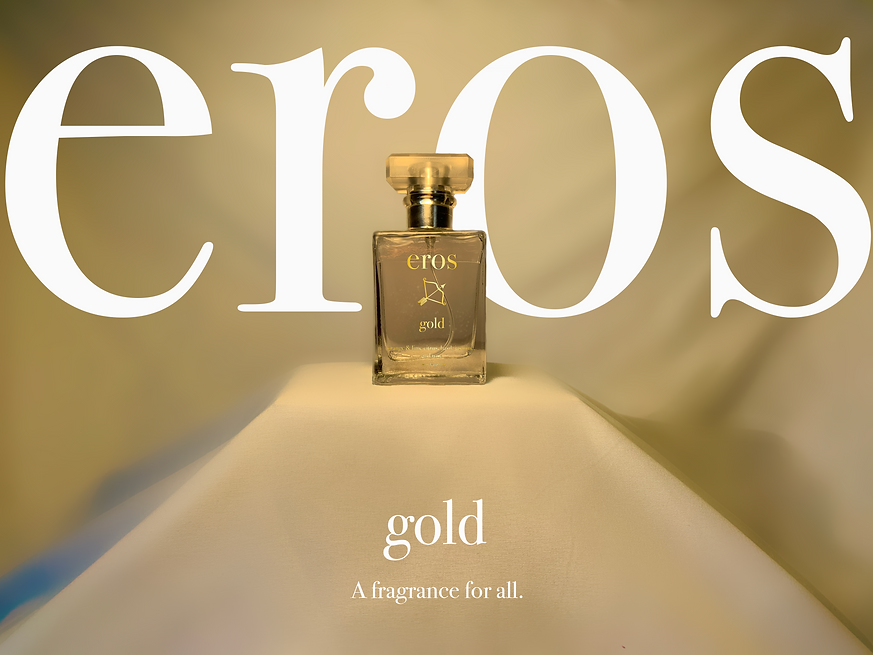
Eros Gold
Eau de Perfume
Orange & Lime Citrus Scented with Basil, Jasmine, and Rose Tones